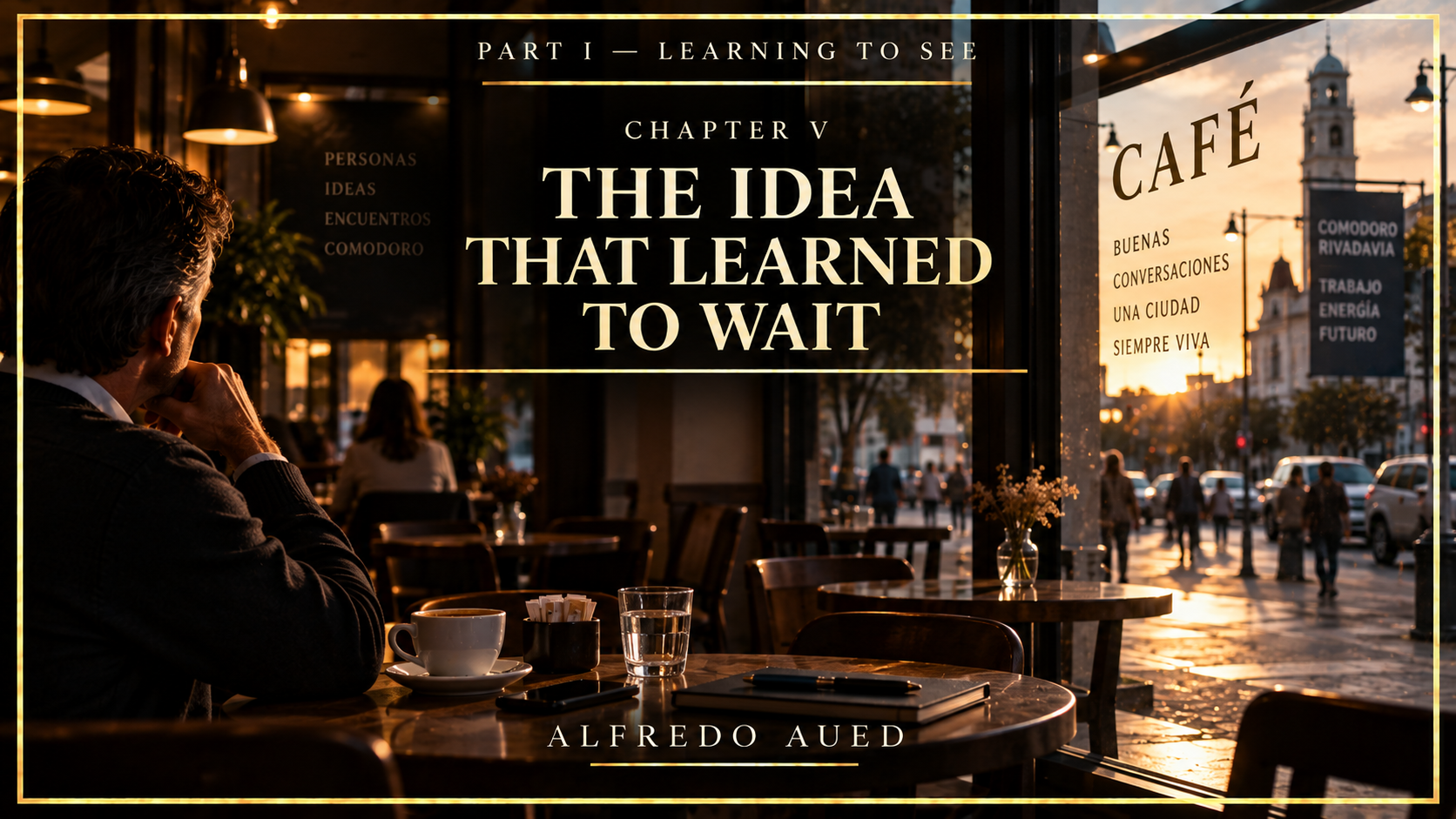
It was around that time that an idea I had known for years returned. I could not say exactly when it had first appeared because it had never taken the form of an inspiration. It was more like a quiet companion that would disappear completely for long periods, until I came to believe I had left it behind. Then, without anything extraordinary happening, it would return as I walked along a hotel corridor, waited for a meeting to end or drove home. It never demanded to be heard. It seemed content simply to remind me, every now and then, that it was still there.
Over the years, I learned that some ideas are very much like certain people. They do not need to draw attention to themselves in order to remain present. They wait, observe, accept that their time has not yet come and withdraw again without complaint. This was one of them. It had been born when the hotel was going through some of its best years and, precisely for that reason, there was always a reasonable argument for allowing it to wait a little longer. As long as occupancy remained strong, reservations continued to come in and the business preserved the balance we had built over so many years, any different project seemed more of a distraction than a necessity. I never felt that I was giving up on the possibility. I simply allowed it to rest, convinced that if it were ever truly needed, it would return.
And it did, as though throughout all that time it had never really gone away.
It did not happen on any particular morning or after some revealing conversation. The idea returned with the same discretion it had always possessed, although this time something was different. Instead of disappearing again a few days later, it began to accompany me with an unfamiliar persistence. It no longer appeared only while I walked through the hotel. It left with me at the end of the working day, remained present on the drive home and reappeared the following morning as I waited for the dashboard to finish loading. It did not occupy all my attention, but remained somewhere in the back of my mind, like those melodies you think you have forgotten and which return again and again without asking permission.
As the weeks passed, I discovered that my routes had begun to change as well. It was never a conscious decision. I simply stopped taking the shortest way home. Some afternoons I returned through the city centre; on others, I parked a few blocks away and continued walking without any particular destination. If someone had asked me why, I probably would not have known what to say. I did not even feel that I was looking for anything. I simply needed to remain in the city a little longer before going home.
The walks eventually became a habit. There were days when I covered several blocks without paying much attention to the shops or the people passing beside me. Or at least that was what I thought. Only much later did I understand that I had begun to look differently. I was not searching for specific answers. What I was trying to understand had not yet taken the form of a question. And yet I almost always returned with the feeling that I had seen something that, only a few hours earlier, had remained hidden, much as a photograph slowly begins to reveal details that had been there from the beginning without anyone noticing them.
The first signs were so subtle that for a long time I wondered whether I had really seen them at all. On an ordinary Wednesday, I might find a restaurant with several empty tables at an hour when it had once been difficult to get a seat. A café that used to remain full until well into the afternoon would begin to fall quiet much earlier than usual. A shop might close its doors a little earlier and no one seemed particularly surprised. They were small changes, almost invisible to anyone with no reason to notice them. Yet after so many walks, I had begun to discover that cities speak in much the same way as people do: they rarely say important things all at once.
The conversations eventually confirmed what my eyes had only begun to suspect. A supplier would mention, with a casualness that concealed a certain resignation, that an investment would have to wait. A shopkeeper spoke of budgets being reviewed again and again before any decision was made. At another table, someone mentioned that certain trips no longer seemed essential because many meetings could be dealt with without leaving the office. None of those remarks, on its own, explained what was happening. They did when they began to recur in different voices, in different places and with a persistence that could no longer be attributed to chance.
I remember one afternoon in particular. I went into a café with no purpose other than to sit for a few minutes before going home. I chose a table by the window and ordered what I always did. Outside, the city continued moving with the same appearance of normality I had known for years. Cars moved along at their usual slow pace, some people walked while looking at their watches and others went in and out of shops without anything seeming to disturb the everyday rhythm. For quite a while, I did not think about the hotel. I simply watched.
That was when I realised that, without noticing it, I was no longer looking at a café.
I was looking at the city.
And for the first time, I understood that what was happening in front of me had far more to say about the future of the hotel than any occupancy chart.
The dashboard remained an extraordinary tool for understanding what had already happened. The city, on the other hand, was beginning to show me what had not yet appeared on any spreadsheet. One spoke of the immediate present; the other hinted at the future. For years, I had relied almost exclusively on the first. Only then did I understand that the second had been trying to get my attention for a long time.
That discovery also changed the way I began to walk through the hotel restaurant. Until then, I had always seen it as a necessary service for those staying with us. Its purpose was to accompany the guest experience with the same level of care as the front desk, the rooms or maintenance. I had never asked anything else of it. It was an important part of a much larger mechanism.
But as the city slowly began to reveal what was changing, the restaurant stopped looking like an operational department to me.
I began to see it as a place.
The difference may seem like little more than a matter of words, but it was not. I understood that a department exists to perform a function within the hotel, whereas a place can acquire a life of its own and be chosen even by people who will never sleep in one of its rooms.
I did not arrive at that conclusion overnight. The idea continued to accompany me for weeks, returning with the same patience with which it had waited for years. Every time I crossed the dining room during breakfast, I found myself imagining, almost without intending to, what that same space might look like a few hours later if it were also filled with people who lived in the city. I no longer saw only tables, chairs or cutlery. I began to imagine encounters, conversations and movement. Without realising it, the restaurant was ceasing to be the end of the guest experience and becoming a possible doorway into the hotel.
For years, I had believed that my job was to attract travellers to the hotel. Those walks led me, for the first time, to ask a different question.
What would happen if the city could find a reason to come inside?