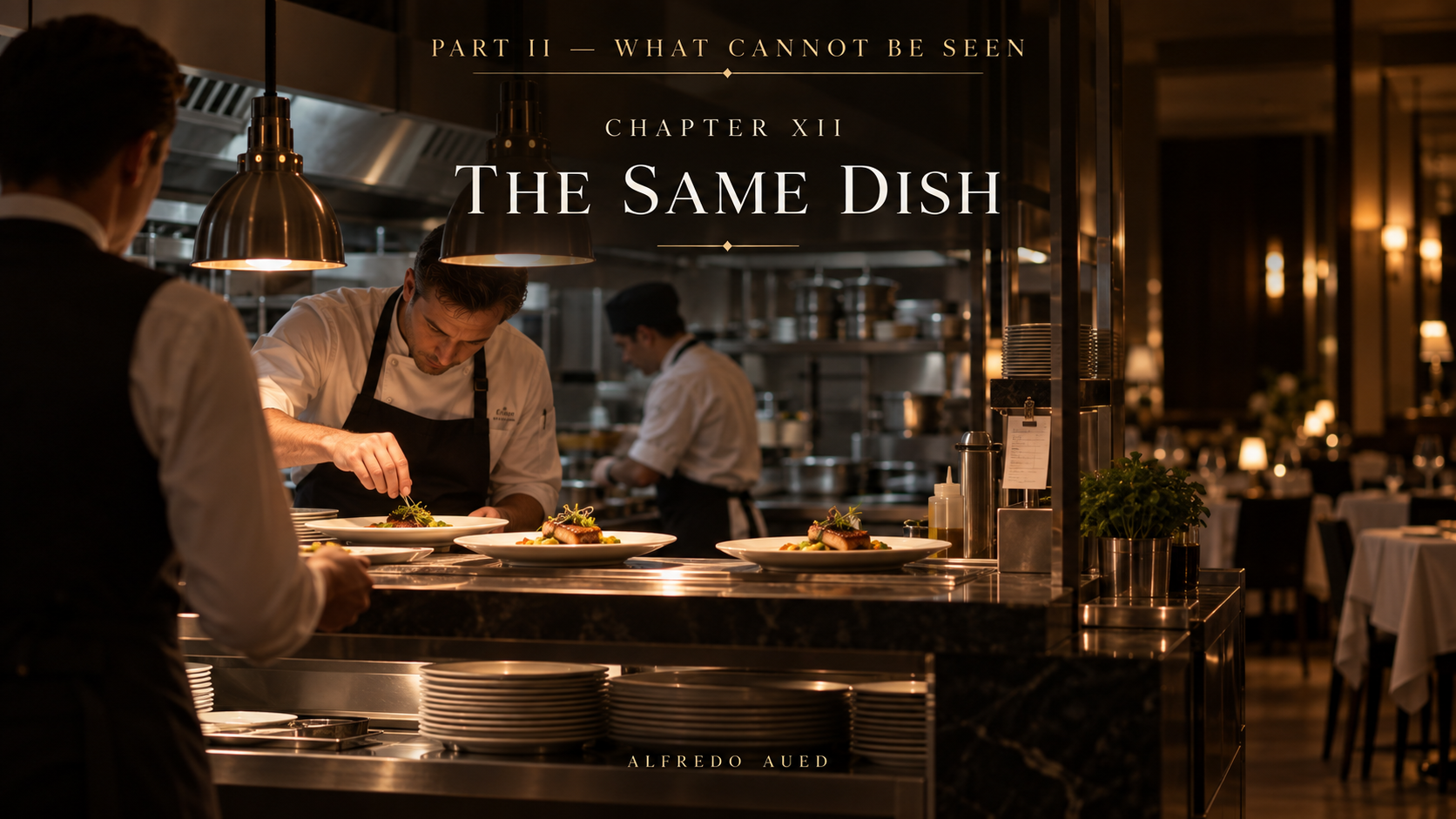
The first time someone pointed out the difference to me, I thought it was probably a matter of the guest’s perception. He had eaten lunch in the hotel restaurant and, that same evening, ordered the same dish again. He had liked it enough to have it a second time only a few hours later.
When it arrived at the table, he looked at it for a few seconds and called the waiter over. He was not making a complaint and did not say that it had been badly prepared. He simply asked whether it was the same dish he had eaten at lunchtime.
The waiter confirmed the order, checked the ticket again and eventually went back to the kitchen to make sure. The name was the same. So were the main ingredients. Yet the presentation had changed, the proportions of some elements were not exactly the same and there were small differences in the preparation that, to someone who worked with those dishes every day, might have seemed insignificant. To the guest, they had not been.
The waiter returned to the table and answered with the appropriate caution:
“Yes, sir. It is the same dish. Let me check why there are some differences from the one we served you at lunchtime.”
The explanation appeared a few minutes later, although no longer in front of the guest. In the kitchen, it was considerably simpler:
“On this shift, we prepare it this way.”
That sentence described rather well something I had lived with for years without thinking too carefully about its consequences. As in many of the hotel operations I had managed, the kitchen needed to cover long working days and very different rhythms. There were breakfasts, lunches, dinners, preparation, production and periods when restaurant activity overlapped with the hotel’s own operational needs. For that reason, I had generally chosen to work with two chefs in charge on complementary shifts.
Operationally, it made sense. Each could run the service, organise production, supervise the team and ensure that the kitchen maintained continuity throughout the day. The difficulty was that continuity of hours did not always mean continuity of judgement.
Experienced cooks tend to develop a highly personal relationship with their craft. They understand techniques, ingredients and degrees of doneness; they have repeated certain processes thousands of times and can detect in seconds things that others would never notice. That confidence is part of what makes them valuable. But in my experience, the greater the technical ability of some cooks, the stronger their conviction could also become that they knew the best way to do things. And very often they had good reasons to think so, which made the problem considerably more complex than simply correcting someone who was cooking badly.
If one of the chefs in charge believed a sauce needed a different texture, they might adjust it slightly. If they preferred a particular presentation, they might find a way to improve it. A garnish could contain a little more of one ingredient, a piece of meat might be prepared according to a slightly different criterion or the finishing touch might change because, from their perspective, the dish was better that way. The chef in charge on the other shift might have exactly the same confidence and arrive at a different conclusion.
Neither of them was necessarily cooking badly. Sometimes something more difficult was happening: both could be cooking well and yet the restaurant was serving two different dishes.
That guest’s observation forced me to look at the problem differently. Until then, when faced with differences like these, my natural reaction had been to determine which of the two versions had been better executed. We compared recipes, spoke with the kitchen, reviewed presentation, portion sizes or procedures and eventually decided how the dish should leave the kitchen. Over time, I understood that the important question was not which cook was right, but something much more basic: what had the customer ordered?
The guest did not know who was working in the kitchen and had no reason to know. We could not expect him, before ordering something he had enjoyed again, to ask who was on duty in order to discover which version he would receive that night. He had ordered the same dish in the same restaurant, only a few hours apart. From his point of view, everything else was irrelevant.
That was when I began to think differently about standardisation. Until then, I had understood it mainly as a necessary tool for organising production, controlling costs and achieving consistency. There were recipes, portion weights, presentation photographs, procedures and yields that helped organise a kitchen and reduce the inevitable variations of any food operation. But a standard recipe could represent something simpler and, at the same time, more important: the version of that dish the restaurant had decided to offer.
That did not mean denying the cook’s judgement. I had always thought it absurd to hire capable people and then ask them to leave their knowledge at the kitchen door. A good cook should observe, propose, correct and help improve the product. Many of the best menu changes we made over the years came precisely from the people who worked every day in front of the stove. The limit lay in distinguishing between proposing a change and applying it individually during service because someone believed their version was better. The first could improve the restaurant; the second could turn every shift into a different restaurant.
That distinction was especially visible in operations connected to a hotel. A customer at an independent restaurant might wait weeks before ordering the same dish again. A hotel guest staying for several days might have breakfast, lunch and dinner with us throughout the entire stay. They saw the shifts change, even if they did not know the people working behind them, and had many more opportunities to notice what we might internally regard as a minor variation.
That was why writing recipes was not enough. The difficult part was getting two people with experience, judgement and personality to accept that, during service, they were not preparing their own version of a dish but reproducing a shared decision. That did not prevent the decision from changing. If someone found a better preparation, we tested it; discussed costs, timing, product availability, customer acceptance and whether it could be reproduced on both shifts. If the change worked and we decided to adopt it, the standard changed as well. What no longer made sense was for it to change simply because the person standing in front of the stove had changed.
That tension appeared again and again in different forms. Sometimes the chef in charge of the morning shift considered unnecessary a preparation left by the evening team. At other times, the evening shift corrected something produced earlier because they preferred to do it differently. The differences might begin around a sauce or a mise en place and, if no one intervened, gradually turn into a kind of silent competition between shifts.
There was not always an open argument. Often it was enough to hear phrases such as “they made that this morning” or “we do it differently at night.” They sounded like technical observations, but over time I learned to recognise something else within them: small boundaries beginning to appear inside a kitchen that, to the customer, was still only one kitchen.
The solution was never to try to eliminate those differences by issuing an order. Professional knowledge does not disappear because someone writes a procedure, and pride in one’s work can be an extraordinary source of quality when it finds the right place to express itself.
But even when we managed to agree on what should leave the kitchen, another problem remained. Between what we had decided and what finally reached the table lay several metres of distance, and within those metres was the dining room.
For a long time, I had thought of the kitchen and dining room as two complementary parts of the same operation, but over the years I arrived at a distinction that helped me understand their responsibilities. Allowing for the obvious differences, I began to think of the kitchen as the restaurant’s factory. Raw materials arrived there, ingredients were transformed and what would later be served was produced. The dining room occupied the commercial end of that process: it spoke to the customer, interpreted what they were looking for, explained the menu, recommended, sold and finally delivered the product.
That position gave the waiter information the kitchen did not always have. The waiter might have explained that a particular dish came with a specific garnish, that a preparation had certain characteristics or that what the customer was ordering was exactly the same thing they had eaten the day before. When the plate appeared at the pass, the waiter did not need to know more about culinary technique than the cook in order to recognise that it did not match what had just been promised.
For that reason, in our restaurants the dining room eventually also took on a quality-control function. The idea was simple: a waiter could not take to the table something different from what had been sold.
In practice, it was considerably less simple. I remember more than once seeing a plate stopped at the pass while the rest of the service continued moving around it. The waiter would look at it, check something and call the cook over.
“This doesn’t go out like this.”
For the person in the kitchen, after preparing dozens of orders in the middle of an intense service, that sentence could be particularly irritating. There was professional knowledge behind the plate, pressure from timing and often the sincere certainty that it had been prepared correctly. Having a waiter send it back could easily be interpreted as interference in territory that did not belong to them.
From the other side, the waiter was not necessarily arguing about culinary technique either. They were the person who had to cross the dining room carrying that plate, set it down in front of the customer and answer for what it contained. If they knew it did not match what had been offered, taking it to the table anyway meant carrying an internal problem all the way to the person who should have had the least involvement in it.
Many frictions began around that pass. The kitchen could feel that the dining room sent dishes back too easily; the dining room, that the kitchen did not listen to what customers were saying. A returned plate could quickly become an argument about who was right, at precisely the worst possible time for such an argument: while orders continued coming in and other tables were still waiting.
My role in those situations was not to decide which department should prevail over the other. If I turned every difference into a dispute between kitchen and dining room, I only reinforced the boundary we needed to remove. We had to return to the plate and ask something much simpler: what had we decided to serve, and what had we promised the customer?
The answer did not always favour the same side. Sometimes the kitchen was right; at other times, the waiter was. And on some occasions, the discussion revealed that the problem existed before either of them: the recipe was not sufficiently clear, the menu described a preparation poorly, a change had not been communicated to the other shift or we had left too much room for different interpretations.
That also changed the way I understood control. For a long time, I had associated the word with supervising whether people were doing their jobs correctly. Later, I understood that in operations where several areas contribute to the same experience, control can also mean ensuring that one person sees what another can no longer see from their own position. The cook looked at the dish from the perspective of technique and production; the waiter, from the promise they had just made; the customer, finally, from something even simpler: what they expected to receive. None of those perspectives was sufficient on its own.
Over the years, we stopped arguing about many of those differences, although they never disappeared completely. In gastronomy there will always be some room for interpretation and there will always be people who want to put something of themselves into what they do. I do not think that should be eliminated. Much of hospitality would lose its meaning if every gesture became a mechanical repetition. But I learned to distinguish between what a person could contribute to the product and what the customer had the right to find again.
I still remember the guest who ordered the same dish twice in one day. He did not make a major complaint or trigger a meeting. He probably never knew that his comment had placed before us a discussion that went far beyond that dinner.
Much later, during another service, I found myself once again near the pass. The shift had changed and someone else was working in the kitchen. A waiter waited while one of the dishes was being finished. When it was placed in front of him, he looked at it for a moment before picking it up. He did not ask who had prepared it, did not need to compare the presentation and did not send it back. He simply lifted it and walked towards the dining room.
As I watched him move away, I understood that this was what we had ultimately been trying to achieve all those years: not for two cooks to cook in exactly the same way, nor for the dining room to learn to think like the kitchen, but for all those differences to disappear exactly where they needed to disappear, before reaching the table.