After going through the website, business profiles, booking platforms and references published by third parties, I had, for the first time, the sense that I was facing too many voices. They were all talking about the same property, although they did not necessarily say the same things or attach importance to the same aspects. I could have continued gathering information, but I was beginning to understand that accumulating sources would not, by itself, bring me any closer to the identity I was trying to reconstruct. I needed to find a point from which that conversation could begin to organise itself.
So I returned to the guest reviews. Until then, I had read them much as we usually do in hospitality: looking at the overall rating, identifying praise, paying attention to criticism and trying to discover whether there was an operational problem that required a response. This time, I decided to read them differently. I stopped asking whether they were positive or negative and began observing what had remained in the memory of those who had stayed at the hotel.
At first, I thought I would find an enormous degree of variation. After all, every guest had experienced a different journey, stayed in different rooms and arrived with expectations of their own. Yet as I continued, exactly the opposite began to happen. The people and the words changed, but certain feelings remained.
The predictable things appeared first in the comments: the rooms, cleanliness, breakfast, location, views and décor. But after reading them one after another, certain recurring patterns began to emerge that did not depend on any particular word. Some guests remembered being welcomed with a drink prepared especially for them. Others mentioned breakfast served beside their room, help booking a table or arranging a taxi, fresh flowers, carefully chosen tableware, or the way someone on the team had shown concern when they were unwell. In several comments, members of staff were mentioned by name, as though they had become an inseparable part of the memory of the trip.
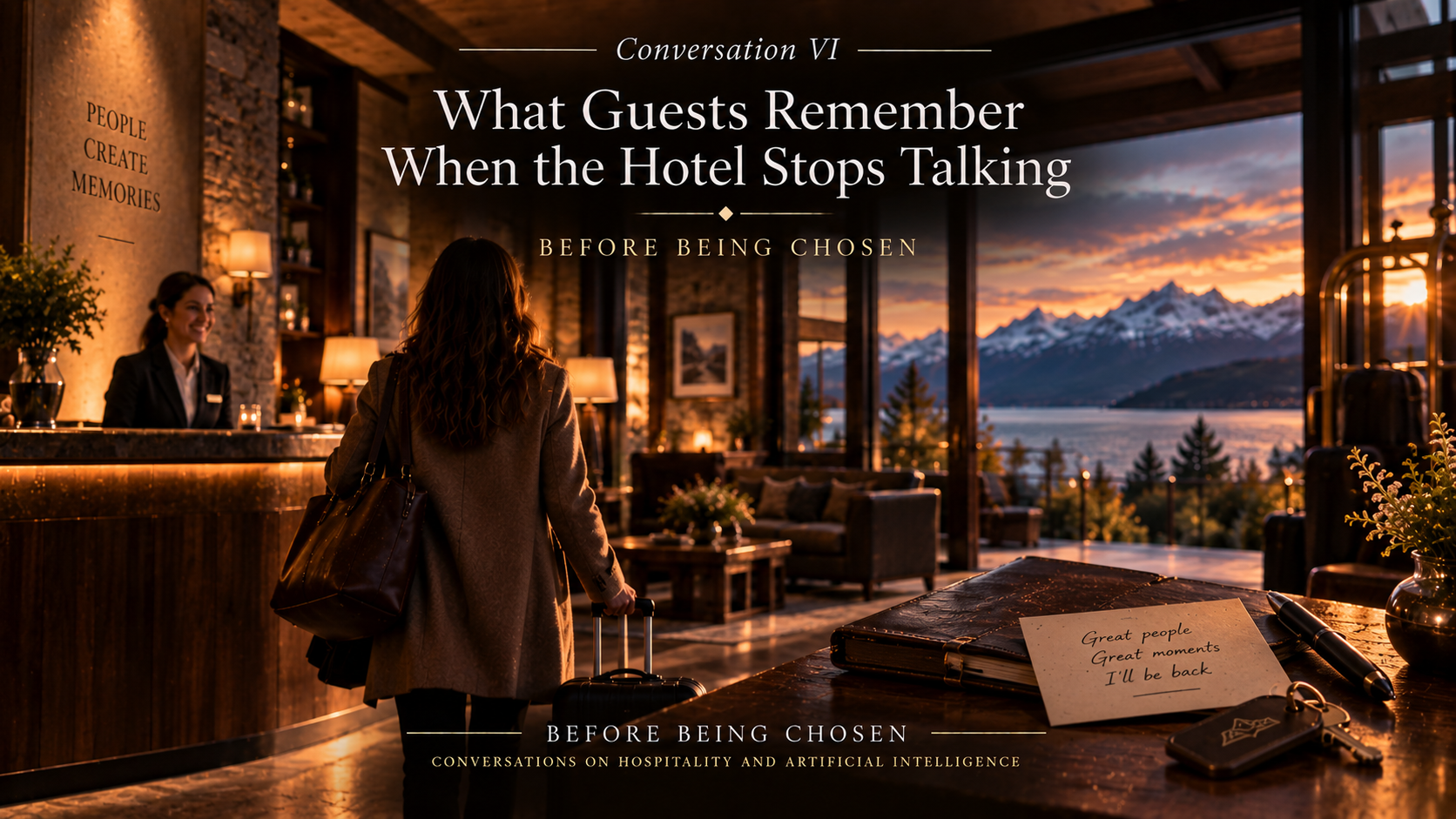
The further I went, the clearer it became that these people were not simply remembering services, but a way of being looked after. The rooms, the landscape and the gastronomy continued to appear in the reviews, but they no longer occupied the centre of the memory. They became the setting against which guests ultimately remembered something deeper: the way they had been treated.
I also found less favourable observations. Some travellers mentioned the distance from the town centre, the need to use taxis, certain awkward room layouts, or a breakfast system that required them to decide in advance what they wanted to eat and at what time. Those criticisms did not undo the pattern. In many cases, even guests who questioned some aspect of the operation still emphasised the kindness of the team and the way problems had been handled.
That was when I began to understand that an individual review might tell us very little about a hotel’s identity. It might reflect a personal expectation, an exceptional incident or a preference that could not reasonably be generalised. But when travellers who had never met one another remembered the same feeling in different words, it ceased to be an isolated opinion and began to form a pattern of memory. Reviews no longer appeared merely as a rating system, but as the hotel’s collective memory: an imperfect, yet extraordinarily valuable, record of the identity the property had left in the memory of those who experienced it.
It was then that I noticed another distinction I had never considered. Until that point, I had been trying to discover the hotel’s identity by reading what the property said about itself. Now I was trying to discover it by observing what guests chose to remember after they had left. And I realised that the two did not always coincide.
Some hotels clearly communicated what they intended to be and succeeded in leaving that same idea in their guests’ memory. The opposite could also happen: properties whose communication insisted on certain attributes while those who had actually experienced the hotel remembered entirely different ones. When that distance appeared, identity began to fragment, because the hotel told one story and its guests ended up telling another.
That was when I understood something that would change the method once again. Perhaps a hotel’s identity could not be discovered solely by reading what the property said about itself, but by listening to what its guests continued to remember long after they had gone.
Management Perspective
A hotel’s identity acquires real strength when what the property says about itself coincides with what consistently remains in its guests’ memory. Reviews then cease to be merely an indicator of reputation and become a tool capable of revealing the patterns of memory that define the experience.
The Case Study
In the next conversation, we will compare the two narratives. On one side, the identity the hotel attempts to communicate through its digital presence. On the other, the identity that emerges from the collective memory of those who have already experienced it. When those two stories are sufficiently compatible, a more consistent identity begins to emerge.
A Question Before Moving On
If you gathered all your hotel’s reviews today and removed the ratings, what feeling would appear most often in your guests’ memories? Does it genuinely coincide with the identity your property is trying to communicate?