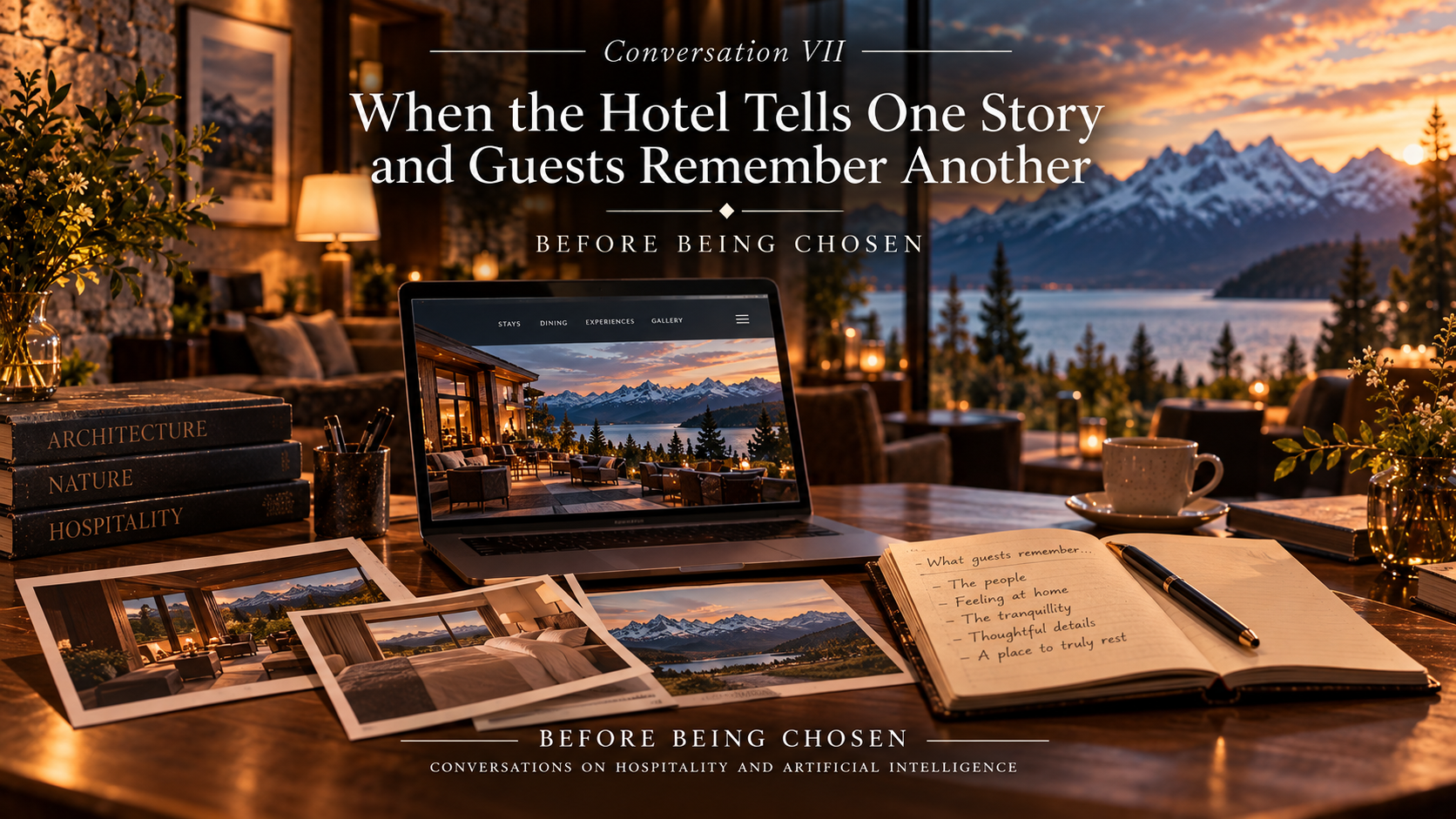
For several days, two very different lists sat side by side on my desk. In one, I had gathered the ideas the hotel was trying to communicate through its digital presence: its architecture, the landscape, its tranquillity, its boutique character, the aesthetic care given to every space, and the promise of an experience designed for travellers seeking to rest away from the usual pace of larger properties. On the other were the feelings that appeared again and again in the reviews of those who had already experienced the hotel.
For a while, I looked at them separately, as though they belonged to different exercises. Only later did I realise that the real work lay in placing them opposite one another.
I was not trying to determine which of the two described the hotel more accurately. I wanted to answer a much simpler question: were they really talking about the same place?
At first, the answer seemed obvious. After all, both the website and the reviews referred to the same property. Yet the more I compared the two narratives, the clearer a difference became that had until then gone unnoticed. The hotel’s official communication organised the experience around the setting: the architecture, the landscape, the design and the surroundings. The reviews, by contrast, ultimately organised it around the people.
That did not mean there was a contradiction. The photographs showed exactly the building in which the travellers had stayed. The landscape was the same one that appeared in their memories, and the rooms were still those they described as comfortable and welcoming. None of that was untrue. What changed was the hierarchy through which each narrative organised the experience.
It was then that the difference I had been trying to understand for several days became clear. It had nothing to do with the accuracy of the information or the quality of the communication, but with the point from which each story began. While the hotel chose to begin its story with what it could show, guests began theirs with what they had felt.
That observation changed, once again, the way I read a hotel’s identity. For a long time, I had assumed that differences between official communication and reviews were simply inevitable nuances. Now I was beginning to suspect that precisely within that distance might lie some of the most valuable information in the entire assessment.
So I went through both lists again, this time looking for similarities rather than differences. Tranquillity appeared in both narratives, although expressed in different ways. The hotel communicated it through its architecture, the landscape and the design of its spaces; guests remembered it by speaking of the silence, the rest, the unhurried rhythm of the place and the feeling of being genuinely looked after. The same was true of hospitality. The hotel’s official communication suggested it as part of the proposition, while the reviews turned it into specific stories involving people whose names continued to appear long after the journey was over.
I then understood that the consistency of an identity did not depend on every source using the same words, but on all of them ultimately leading towards the same idea. No hotel needs to repeat exactly the same expressions across every channel. What it needs is for all those voices, beneath the surface, to build a coherent impression.
Until then, I had been looking for contradictions. I expected to find hotels whose communication promised an experience completely different from the one their guests described. Such cases, of course, existed and were probably the easiest to detect. Yet I began to discover a far more common and, at the same time, more interesting situation. Many hotels were not communicating the wrong identity; they simply were not managing to express clearly enough what their own guests ultimately found unforgettable.
The difference may seem small, but it completely changes the way we interpret a digital presence. A hotel can devote enormous effort to perfecting the aspects it chooses to show and still leave in the background the very thing that truly explains why people want to return or recommend it.
It was then that I realised that comparing the two narratives was useful not only for assessing the coherence of the hotel’s communication. It could also reveal opportunities that might remain invisible to the hotel itself. Where the declared identity and the remembered identity coincided, there was a strength worth reinforcing. Where they began to diverge, there was an opportunity to better understand what the hotel was still failing to explain.
That distance was not a subjective impression. It was an observable reality that could be read, compared and, with a sufficiently rigorous method, managed. Until then, I had learned to listen to the conversation taking place around a hotel. Now I was beginning to discover that the same conversation could measure something much deeper: the distance between the identity a hotel was trying to build and the one it ultimately managed to leave in its guests’ memory.
I then had the sense that, for the first time since these conversations began, I was no longer simply learning to understand a hotel’s identity. I was beginning to understand how to diagnose it.
Management Perspective
A hotel’s identity becomes more consistent when the story the property communicates is compatible with what repeatedly remains in its guests’ memory. Comparing the two narratives makes it possible to identify genuine strengths, recognise meaningful differences and discover which aspects of the experience should occupy the centre of the hotel’s identity.
The Case Study
In the next conversation, we will try to take this one step further. It will no longer be enough to establish whether the two narratives align. We will begin to identify the different kinds of distance that can emerge between declared identity and remembered identity, and examine how those differences can guide concrete decisions about communication, experience and positioning.
A Question Before Moving On
If you compared the story your hotel tells about itself today with the one spontaneously told by those who have already stayed there, would they be describing the same experience, or simply the same building?