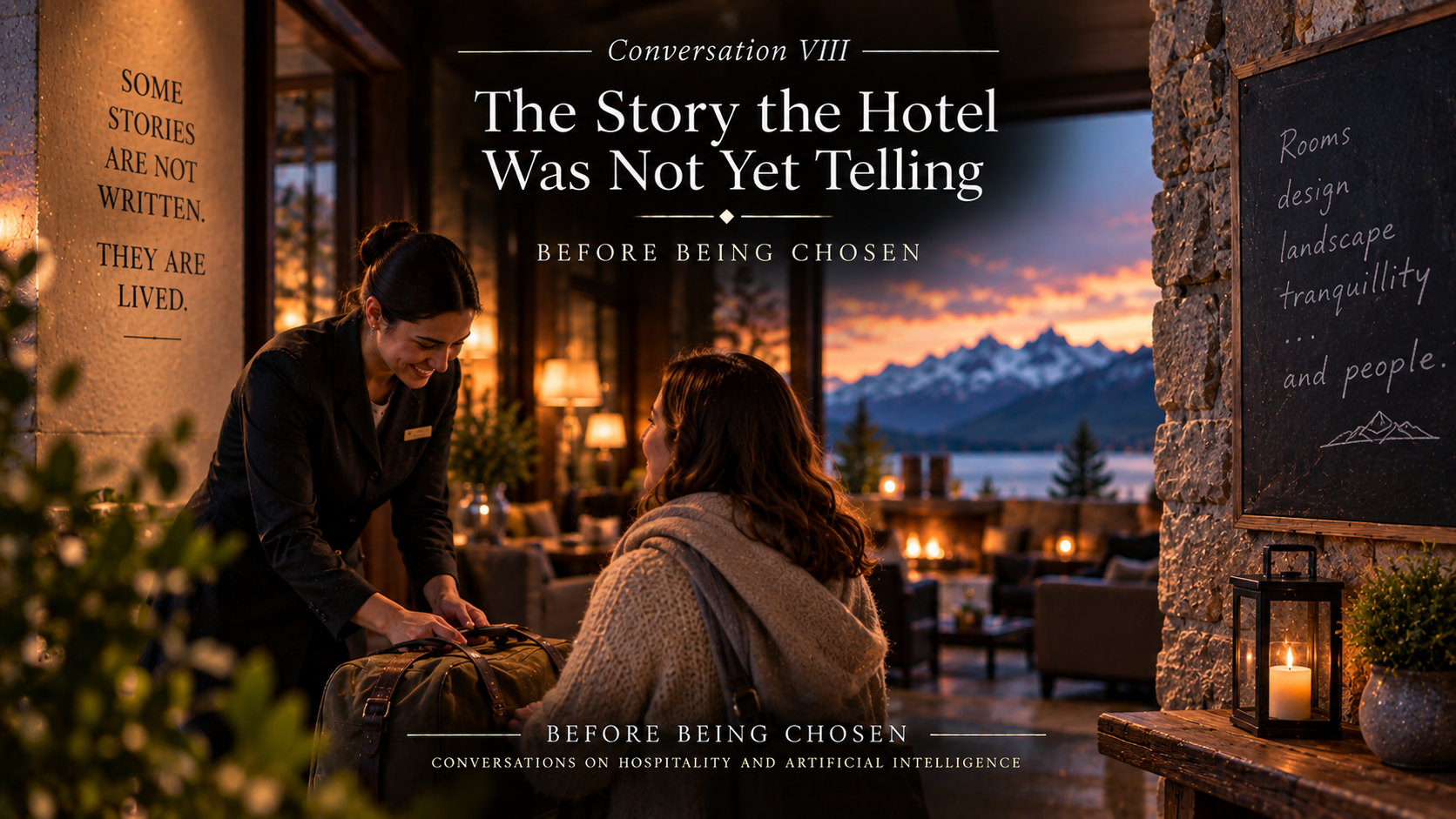
For several days, I continued looking at the two lists I had placed opposite one another. I was no longer trying to establish whether the digital presence and the reviews were talking about the same property. I knew they were. The architecture, the landscape, the tranquillity and the care given to the spaces appeared in both narratives, although they did not occupy the same place. What I still could not explain was why, despite that broad consistency, a certain distance remained between the story the hotel chose to tell and the one its guests carried with them in their memory.
At first, I thought that difference might simply be due to the nature of each source. A website needs to organise information, present rooms, show photographs and facilitate a booking. Reviews, by contrast, emerge after the experience and often linger on scenes that no hotel could ever fully anticipate. It seemed reasonable that the two narratives should speak different languages. Yet the more I compared them, the more evident it became that the difference lay not only in how each story was told, but also in what each had chosen to place at its centre.
The hotel’s official communication described with great care the setting in which the experience took place. It showed the architecture, the landscape, the interiors, the serenity of the surroundings and a boutique proposition built around design and rest. Everything was presented accurately and corresponded with what guests found when they arrived. There was no exaggerated promise or false representation of the property. The problem was more difficult to notice precisely because the story the hotel was telling was true.
The reviews, however, seemed to complete a part of that story that the hotel’s official communication only hinted at. Travellers spoke of people who had called them by name, of someone who had adapted breakfast to their needs, secured a reservation, waited for a late arrival or noticed a need before it had been expressed. They remembered small gestures, conversations and acts of care that could not be photographed as easily as a room or a landscape, but that ultimately occupied a far more enduring place in their memory.
It was then that I understood that I was not looking at two incompatible identities, but at an incomplete one. The hotel was not communicating something different from what its guests experienced; it was communicating only part of the story. It had succeeded in explaining precisely the place in which hospitality happened, but it had not yet managed to show with the same clarity the particular way in which that hospitality was practised. The building, the surroundings and the design created the setting, while the people turned that setting into an experience capable of remaining in memory.
That difference forced me to reconsider an idea I had taken for granted for years. I had always thought that a hotel’s most important strengths were those its communication managed to highlight. Yet here was a strength that worked in exactly the opposite way. It revealed itself every day in the operation, appeared again and again in the reviews and, even so, remained almost invisible within the story the hotel had constructed about itself.
Perhaps that invisibility was not accidental. Organisations easily recognise what they have deliberately designed: architecture, a gastronomic proposition, a room category or a recent investment. They find it much harder to recognise the value of practices that, over time, have simply become their usual way of working. What may seem an extraordinary gesture to a guest may be nothing more to the team than the natural way to welcome someone, accompany them or respond to a need. Some of a hotel’s most valuable strengths may remain hidden precisely because those who create them no longer consider them exceptional, even though the fact that these practices come naturally does not guarantee that people who do not yet know the property will be able to discover them before choosing it.
I went through the website again, imagining what might happen if that personal attention occupied a more visible place within the story. This was not about adding grandiose claims about service or promising a kind of hospitality that could not be demonstrated. It was about allowing the people, the gestures and the small scenes guests remembered to become part of the way the hotel presented itself. The architecture would lose none of its importance, the landscape would remain a reason to travel, and design would continue to define much of the experience. But all those elements would begin to function as the setting for a deeper idea: a place where each guest was looked after in a way that was difficult to confuse with that of any other property.
The comparison was thus beginning to reveal more than a difference in communication. It showed a form of differentiation that the hotel itself had not yet fully recognised. Many properties could offer comfortable rooms, beautiful views or carefully designed spaces; far fewer managed to have travellers from different countries, ages and with different expectations ultimately remember the same human warmth. That strength had not been invented by a campaign. It was supported by the consistency with which it appeared in the memory of those who had experienced the hotel.
It was then that I realised that not every distance between declared identity and remembered identity should be interpreted as a failure. Some might reveal contradictions or promises the operation could not sustain. But the one before me was quieter: the hotel was offering something better than it was able to tell.
That seemed to be the case with the property I had been observing. It was not telling the wrong story, but telling incompletely a story that was better than the one it believed it had.
That conclusion changed the purpose of the analysis once again. Until then, I had thought that comparing the two narratives would reveal errors, inconsistencies or unfulfilled promises. Now I understood that it could also uncover strengths that were still absent from the hotel’s communication. The comparison did not reveal only what the hotel should stop saying. Sometimes, it pointed towards what the hotel finally needed to learn to recognise.
Over time, I began to think that this mismatch needed a name. Not to turn it into a formula or reduce a hotel’s identity to a score, but because naming it would allow us to observe it more precisely. It was the distance that could open between what a property declared, what it actually did and what its guests ultimately remembered. In some cases it was barely perceptible; in others, it completely altered the way the hotel was understood.
I began to call it the identity gap.
Management Perspective
An identity gap does not always reveal an unfulfilled promise. It can also emerge when a hotel possesses a genuine strength that its guests experience and remember, but that the property has not yet managed to incorporate clearly enough into the story it tells about itself. Identifying that distance makes it possible to discover opportunities for differentiation that already exist within the operation before attempting to invent them through communication.
The Case Study
In the hotel we have been observing, the main distance does not arise from a contradiction between promise and experience. Its communication emphasises architecture, landscape, design and tranquillity, while the reviews give extraordinary importance to personalised attention and the warmth of the team. In the next conversation, we will begin to distinguish the different forms an identity gap can take and the decisions each one requires.
A Question Before Moving On
What aspect of your hotel’s experience appears repeatedly in reviews, yet still occupies a secondary place—or does not appear at all—in the story the property tells about itself?