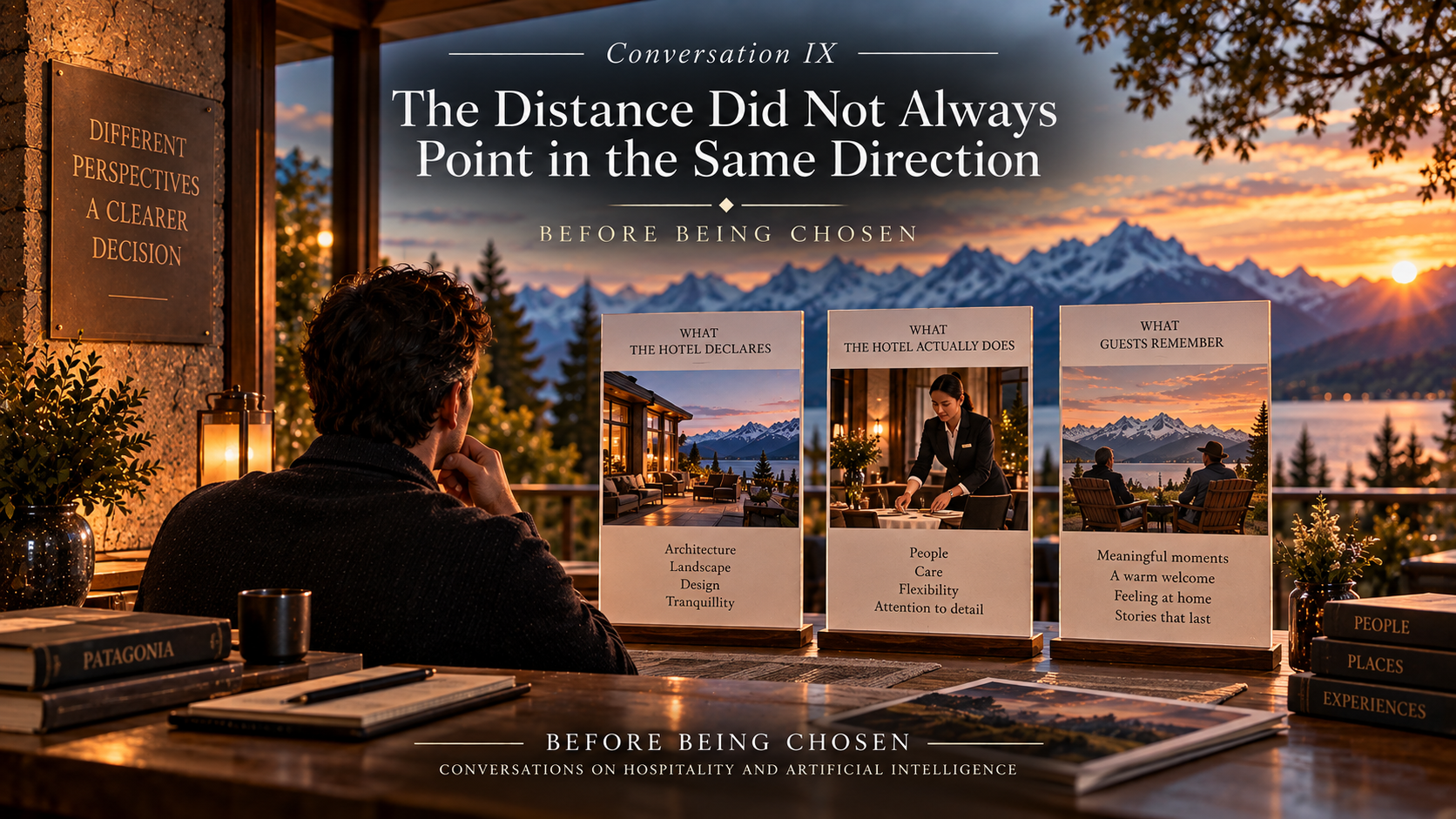
My first reaction was almost immediate. After discovering that personalised attention occupied a far more important place in guests’ memories than in the hotel’s communication, I thought the next step was to address that absence. I imagined new copy, photographs showing the people behind the experience, and small scenes capable of revealing what the reviews described so clearly. For the first time since I had begun the analysis, the answer seemed within reach.
Before moving forward, however, I returned to the gap we had just discovered. In that property, the operation seemed to contain a strength that the communication was still failing to express clearly enough. But what if the situation had been exactly the opposite? What if a hotel promised closeness and personalised attention while its guests remembered indifference, mechanical responses or an impersonal experience?
The question completely changed the solution I had imagined. In the first case, the communication needed to move closer to an experience that already existed. In the second, reinforcing the narrative would only have widened the distance between promise and reality. The words might have sounded similar, but the decision they called for was the opposite.
I understood then that identifying an identity gap was not enough. The distance showed that something did not align, but it did not yet explain what needed to change. Before intervening, it was necessary to discover the direction in which the gap had opened.
I returned to the two lists and added a third. The first contained what the hotel declared about itself. The second, what guests remembered. The new list had to capture something that until then had remained implicit: what the property actually did every day.
The distinction might have seemed unnecessary. After all, reviews emerged from the experience and could, in principle, be regarded as a reasonably faithful reflection of the operation. Yet they were not exactly the same thing. A review recorded what one person had perceived and chosen to remember. The operation also included processes, decisions and practices that could exist without every guest necessarily noticing them. A distance could also open between what the hotel did and what ultimately remained in memory.
I began to organise the analysis around those three dimensions: the declared, the experienced and the remembered. None could explain the hotel’s identity on its own. Communication showed the story the hotel wished to build. The operation revealed whether that story was supported by the everyday experience. Guests’ memories made it possible to see which part of all this managed to remain after they had left.
Looking at the three lists together, some of the differences began to take on a more precise shape. There were strengths present in both the operation and guests’ memories that barely appeared in the communication. Communication could also make a promise that the experience failed to sustain. In other cases, a hotel offered a valuable experience and communicated it accurately, yet external sources described it so fragmentarily that it became difficult to recognise a common identity.
The gap, then, was not a single category. It was a symptom. It indicated that the different expressions of identity had stopped moving in the same direction, although it did not yet reveal which of them needed to move closer to the others.
That idea reminded me how often, in hospitality, we had responded to different problems with the same solution. If bookings fell, we reviewed rates. If a page failed to convert, we changed the copy. If reviews pointed to a weakness, we reinforced training. Any of those responses might be right, but only when it addressed the real cause. Otherwise, we risked perfecting precisely what was creating the confusion.
In the hotel I had been observing, the direction of the gap was beginning to emerge. Personal hospitality was neither an empty promise nor a future aspiration. It was embedded in the operation and appeared consistently in guests’ memories. Communication was the dimension that had fallen behind. We did not need to invent a new experience or ask the team to behave differently. We needed the official story to recognise more faithfully a strength that was already alive within the property.
But that same diagnosis could not automatically be applied to every hotel. If the reviews had described a distant experience while the communication promised closeness, the work would have had to begin with the operation. There would have been little point in photographing smiles, multiplying promises of warmth or writing new declarations of hospitality while the everyday experience continued to produce the opposite memory. In that case, communication would not have omitted a strength; it would have anticipated an identity the hotel was not yet ready to sustain.
A less obvious situation could also arise. A property might communicate a genuine proposition, deliver it reasonably well and receive good reviews, yet express itself in language so generic that it became indistinguishable from hundreds of alternatives. “Comfort”, “excellence”, “prime location”, “personalised service” and “unique experiences” might all describe genuine attributes and still explain nothing specific about the hotel. There, the gap did not arise from a contradiction, but from a lack of precision. Everything could be true without ever becoming identity.
I began to understand that the diagnosis required a different question in each case. When the experience was richer than the narrative, communication needed to be enriched. When the promise exceeded the experience, the operation needed to change. When the two aligned but failed to produce a recognisable impression, the problem lay in hierarchy and differentiation. And when each source told a different version, the task was to reconstruct a common idea before attempting to amplify any of them.
This was not yet about establishing a definitive classification. Hotel identities rarely behave like perfectly separate compartments, and the same organisation could contain several gaps at once. The value of the exercise did not lie in assigning a label, but in avoiding an automatic response. Before correcting a gap, we needed to understand which dimension most faithfully expressed the experience the hotel needed to preserve.
I returned then to the original case. The architecture, the landscape, the design and the tranquillity did not need to disappear from the story. They were real, valuable and unquestionably part of the experience. But they could no longer occupy the entire centre. Personal attention offered an idea capable of bringing them together and giving them a deeper meaning. The landscape explained where the experience took place. The architecture showed the care with which it had been conceived. Hospitality explained why so many people continued to remember it.
For the first time, I could imagine the result of the analysis not as a list of corrections, but as an identity decision. The hotel did not need to become something different. It needed to learn to present itself from the place that best explained what it already was.
That conclusion also changed the way I understood the method. The anonymity test had revealed that the hotel was difficult to summarise. The digital conversation had shown that its identity did not live in a single source. Reviews had revealed what remained in guests’ memories, and comparing the narratives had made a gap visible. But none of those tools, on its own, indicated the solution. The diagnosis only began to become useful when it allowed us to understand which of the available stories should guide the others.
It was then that I understood that an identity gap was not an instruction to change. It was an invitation to decide.
Not every distance pointed in the same direction. Some required communication to learn to recognise the experience more clearly. Others required the operation to rise to the level of the promise. And some required us to abandon words that were accurate but interchangeable in order to find an idea that could belong only to that hotel.
In the property before me, the answer was beginning to take shape. There was no need to invent a new proposition or replace the existing story. It had to be reorganised around what the operation demonstrated and guests confirmed: deeply personal hospitality, offered within a Patagonian setting shaped by tranquillity, beauty and care.
For the first time since I had begun this journey, the method was doing more than showing what was missing. It was beginning to point towards the decision that needed to be made.
Management Perspective
Detecting an identity gap does not automatically determine the solution. Before intervening, it is necessary to understand its direction: whether communication needs to move closer to a strength the operation already sustains, whether the experience needs to rise to the level of a promise not yet fulfilled, or whether both need to be organised around a more precise and differentiated idea. The same distance can require completely opposite decisions.
The Case Study
In the hotel we have been observing, the experience and guests’ memories align in recognising attentive, anticipatory and deeply personal hospitality. The main decision is not to transform the operation, but to reorganise the hotel’s story so that this hospitality occupies the central place currently held primarily by architecture, landscape and design. In the next conversation, we will try to formulate the idea capable of bringing all those elements together without reducing the richness of the hotel to an advertising slogan.
A Question Before Moving On
When you detect a difference between what your hotel communicates and what its guests remember, do you really know what needs to change: the story you tell, the experience you offer, or the idea around which you are trying to organise both?