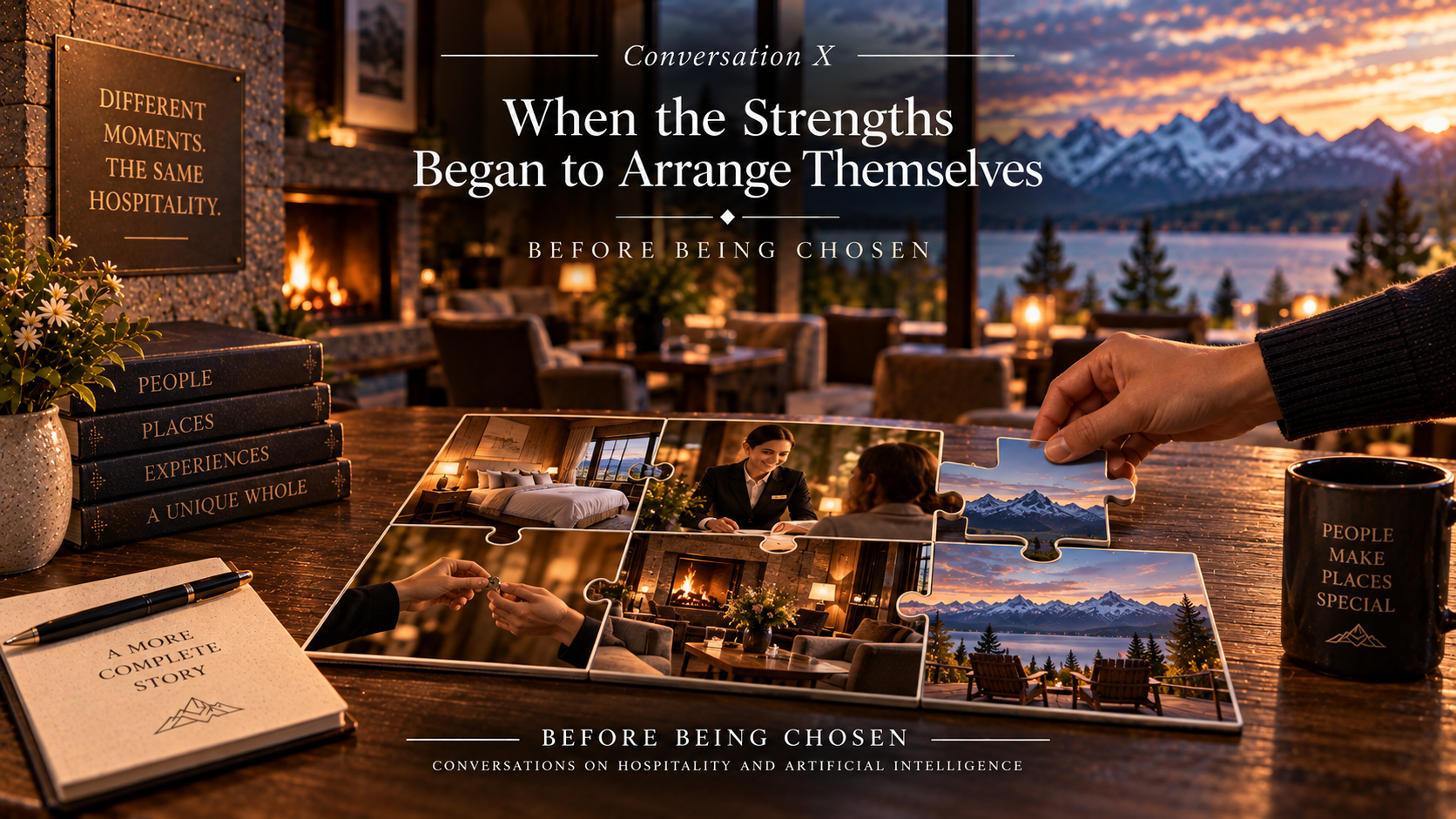
For several days, I continued thinking about the gap we had discovered in the hotel. The explanation had seemed complete. We knew that the communication was not wrong, and we also understood that the reviews were not describing a different property. The identity appeared incomplete because what guests remembered most vividly still did not occupy the same place within the story the hotel told about itself.
Yet the more I returned to the case, the more evident a new difficulty became. Discovering a strength was not enough to reorganise an entire identity.
So I returned to the reviews. This time, I was no longer looking for differences between what the hotel said and what its guests remembered. Nor was I trying to measure how often each comment appeared. I wanted to understand something else: whether all those scenes travellers carried with them in their memories really belonged to different stories or whether, somehow, they were all ultimately speaking of the same idea.
At first, each memory seemed to follow its own path. Some guests mentioned a breakfast prepared especially for them. Others remembered someone on the team securing an impossible reservation, waiting for a late arrival or adapting a room to meet a particular need. Some spoke of people by name, of unexpected conversations or of small gestures that no operating procedure could ever prescribe exactly.
For a while, I looked at each of those scenes as though it represented a separate strength. Yet the more I returned to them, the clearer it became that reading them that way was preventing me from seeing what truly mattered. No guest travelled to remember a breakfast. Nor did they travel to remember a flower, a telephone call or a reservation secured at the last minute. Those scenes remained in memory because, in different ways, they all expressed the same way of understanding hospitality.
That observation changed the analysis once again. Until then, I had gone through the hotel’s strengths as someone might assemble a collection of valuable attributes. Now I was beginning to suspect that many of them were not really the source of the experience, but different manifestations of a deeper idea that still remained hidden. The implications of that became visible in the communication as well. A hotel might try to explain its identity by describing its best qualities one by one, without realising that they all arose from the same way of welcoming, caring for and relating to those who arrived there.
As I went through the website again, I remembered something that, curiously, had never needed to be explained in the architecture of the property itself. The rooms, the common areas, the landscape and the décor might seem different from one another, but no one would imagine that they had been conceived independently. They all reflected the same design intention, even though that intention had never been written down.
I began to wonder whether identity might work in exactly the same way. Perhaps strengths, too, should not be viewed as isolated pieces, but as signals that allowed a common logic to be reconstructed. Perhaps the real task was not to decide which of them should be communicated more strongly, but to discover the idea capable of explaining why they all appeared together.
Until then, I had been trying to identify what the hotel did well; now I was beginning to ask why it did those particular things well rather than others.
Two hotels might offer a memorable breakfast for entirely different reasons. They might also stand out for the attentiveness of their team, the tranquillity of their surroundings or the quality of their rooms. The visible strengths might appear similar. What truly distinguished them was the deeper reason those decisions appeared again and again throughout the experience.
It was becoming difficult to believe that an identity could emerge simply from accumulating attributes. Everything suggested that strengths were important, but for a different reason from the one I had assumed when I began this journey. They no longer seemed to be the destination of the analysis, but the starting point for a far more interesting question.
What idea could explain all of them at the same time?
For several days, I lived with that question without finding a satisfactory answer. The more closely I observed the hotel, the more clearly I could see that its strengths were beginning to arrange themselves around a logic I still could not name. It was there, connecting the team’s decisions, the way guests were welcomed, the way problems were resolved and even the small gestures that appeared repeatedly in the reviews. I could recognise its effects, but I did not yet know what to call whatever was producing them.
It was then that I understood that the next step would no longer be to discover new strengths. What truly mattered was finding what held them together, even though I still did not know how to name it.
Management Perspective
A hotel’s strengths should not be analysed as a collection of independent attributes. When different strengths appear consistently throughout the experience and remain in guests’ memories, it is worth asking what common logic produces them. Finding it allows us to move from describing what a hotel does well to understanding why it ultimately does things that way.
The Case Study
In the hotel we have been observing, personalised attention, spontaneous gestures, the warmth of the team and attention to detail no longer appear to be isolated strengths. Everything suggests that they arise from the same way of understanding hospitality, even though that idea still remains implicit. In the next conversation, we will try to discover what holds them together and how far that logic can help us understand the property’s identity.
A Question Before Moving On
If you had to remove all the visible strengths of your hotel and keep only the idea that makes them possible, what do you think would remain?