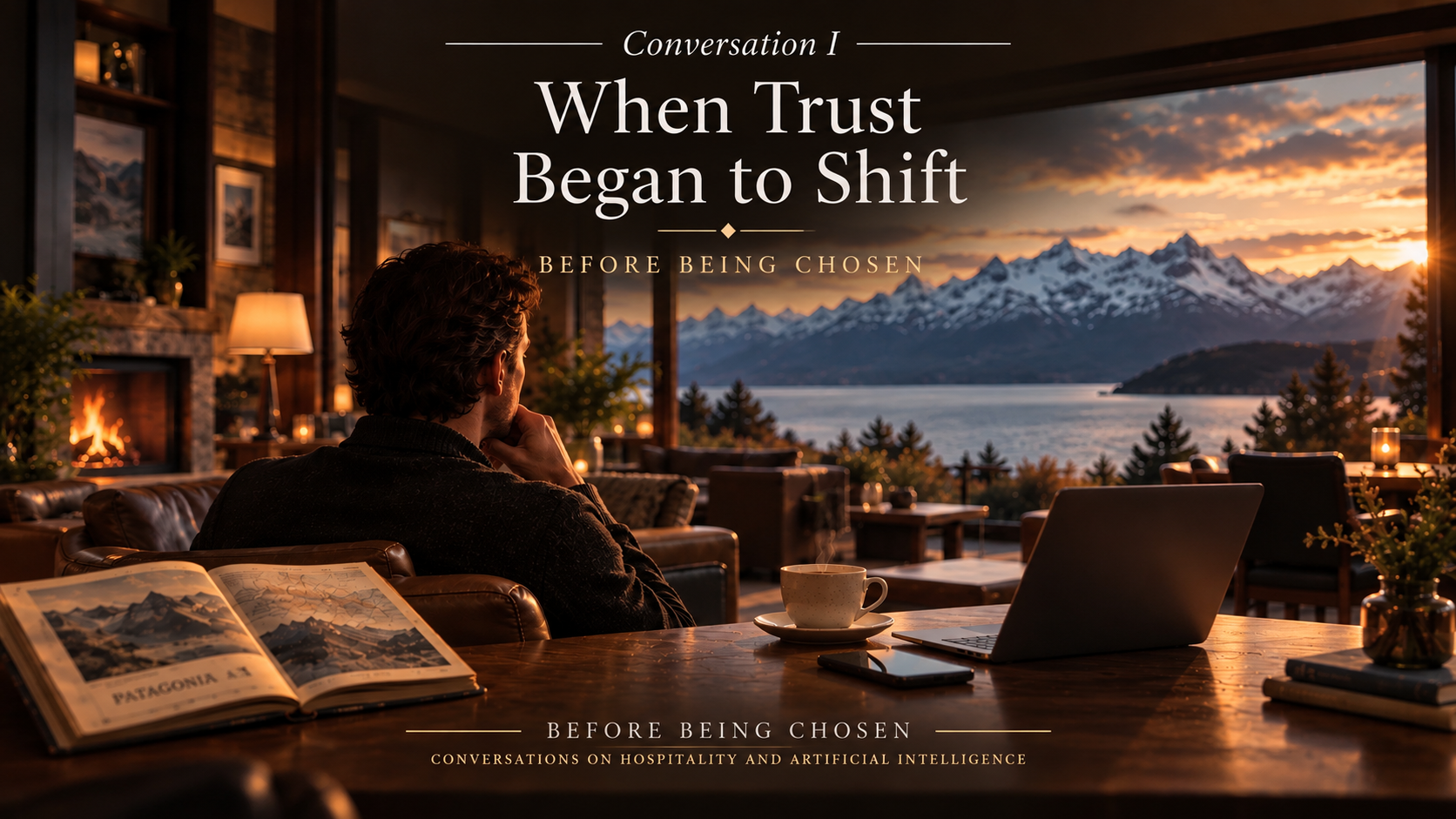
There are professions in which the passing of time is measured in calendars, balance sheets or generations of customers. Hospitality, by contrast, has a much quieter way of counting the years. It measures them by the way guests arrive.
It may seem an unusual thing to say. Yet when you spend enough time in this business, you begin to see that every period in the history of hospitality has been shaped by a different way of building trust. Before there was a reservation, before a guest walked through the hotel door, and even before a destination was chosen, there was always someone — or something — capable of guiding that decision. What changed over time was not simply the tools. Above all, it was where travellers chose to place their trust.
Looking back over the recent history of hospitality, it is easy to forget that for many years a significant number of reservations began across the desk of a travel agency. Those who now arrange their holidays from a phone may find that difficult to imagine, but knowledge about destinations was once concentrated in the hands of very few people. Travellers explained what they were looking for, how long they planned to be away, who they were travelling with and what their budget was. On the other side of the desk sat someone who knew the hotels, the tour operators, the seasons, the flight connections and the excursions. Often, a recommendation was enough to decide where to stay. Guests accepted that suggestion without having seen a room, without knowing the view from the window and, quite often, without having seen even a photograph of the hotel.
Naturally, that was not the only way. Some travellers preferred to build their journeys with an almost painstaking patience. They bought a guidebook, marked pages, folded maps and underlined short passages written by journalists or travellers who had been there long before them. Those guides stayed with them for years. Eventually they would hold museum tickets between their pages, handwritten notes, telephone numbers scribbled in the margins and addresses someone had recommended along the way. They were far more than books: they became the memory of a journey and, at the same time, a way of trusting the judgement of the person who had written them.
When I began my career in hospitality years later, that landscape was already changing. Yet it still retained many of those characteristics. Relationships with travel agencies remained important, reputations were still built slowly, and prestige continued to be an asset no hotel could afford to neglect. We were not yet talking about algorithms, search engines or artificial intelligence. We spoke simply about doing our jobs well, because we knew that a good recommendation still carried a value that was difficult to replace.
The Internet had already begun to reshape that landscape and, as so often happens with major transformations, at first we thought we understood perfectly well what was changing. We believed the great advance was being able to show the hotel without relying exclusively on a brochure or a tour operator. Having a website seemed enough. We carefully selected the photographs, wrote descriptions of the rooms, highlighted the services and tried to convey the personality of the property. At the time, it seemed reasonable to think that the challenge was simply to replace paper with a screen.
In time, we discovered that the Internet had never been merely another way of displaying a hotel. It had changed the way travellers made their decisions. Booking platforms brought dozens of hotels together in one place and, for the first time, properties that had never competed with one another found themselves being compared on the same screen. Suddenly, guests could explore alternatives, filter by price, category or location and, in a matter of minutes, browse a range of options that would once have required weeks of enquiries.
It was not long before an even deeper change appeared. The opinions of other travellers began to occupy a place that had once belonged almost exclusively to travel agencies and specialist guides. I remember clearly the uncertainty caused by the first public reviews. Many hoteliers saw them as a threat. Others quickly understood that this was not a passing trend, but another shift in where trust was placed. The conversation about a hotel no longer belonged to the hotel alone. One family could influence another family’s decision without ever meeting them. A comment written after breakfast could carry more weight than a carefully planned advertising campaign. Once again, authority had moved elsewhere.
As it had so many times before, hospitality adapted. We learned to respond to reviews, measure reputation, pay attention to indicators that had previously seemed secondary, and understand that every experience could become, only a few hours later, the reason another guest chose to book — or to keep looking.
The next transformation came with Google. Having a good website was no longer enough; travellers had to be able to find it. We discovered a new language made up of rankings, authority, content, links and keywords. For years we believed — with good reason — that much of a hotel’s commercial success would depend on appearing among the first results of a search. We learned that logic, invested time and resources in understanding it and eventually absorbed it with the same ease with which we had once learned to work with travel agencies and tour operators.
Looking back, each of those periods seemed to have something in common. The intermediaries changed, the tools changed and travellers’ habits changed, but the journey itself retained a fairly stable structure. Guests needed information, went looking for it and, after comparing different alternatives, made a decision.
For a long time, I thought that sequence was almost a constant of the business. I had watched business models disappear, new ones emerge and hotel distribution transform completely, to the point where I began to believe I had witnessed practically every possible way of arriving at a hotel. Today, I am no longer so sure. While we were all learning to compete for a place in search results, the guest journey was beginning to change once again. The difference was subtle and, precisely for that reason, many of us failed to notice it: for the first time in several decades, travellers seemed to be moving from searching to, quite simply, asking.
I did not notice that change while reading a trends report or attending a conference on artificial intelligence. I discovered it in a far more ordinary way. A former guest, with whom I had remained in contact for several years, sent me a screenshot without much explanation. I assumed he wanted to show me a reservation, a comment about the hotel or perhaps a photograph from his latest trip. Instead, the image showed a conversation.
“What hotel would you recommend for two nights in El Calafate?”
The answer mentioned several properties. I knew some of them very well; I could even describe their strengths and weaknesses from memory. But it was not the names that caught my attention. What mattered was that this traveller had begun planning his trip in a completely different way from the one I had taken for granted for so many years. Instead of opening a search engine, going through dozens of results and comparing alternatives himself, he had simply asked for a recommendation.
For a few days, I thought the difference was merely a matter of language. After all, asking for a recommendation and searching for information could seem like two different ways of reaching the same destination. But the more I returned to that conversation, the clearer it became that something deeper had changed: when people search, they accept that they will have to explore alternatives, compare prices, read reviews and interpret the information for themselves; when they ask for a recommendation, they expect someone to understand the context, discard what is irrelevant and offer a reasoned answer.
I realised then that this logic was not new at all. Hospitality had always lived with it. Travel agents made recommendations. The authors of the great guidebooks made recommendations. And we did the same ourselves whenever a guest approached the front desk and asked us to suggest a restaurant, an excursion or something to do. What was new was that we had never imagined that the hotel itself might become the subject of that conversation. And that realisation led me to a question which, surprisingly, I had never asked myself before.
For years, we worked to make the hotels we managed easier to find. We invested in photography, websites, search positioning, online reputation and hundreds of small details intended to improve their visibility. But had we devoted the same effort to explaining who we really were? Were we able to communicate clearly what kind of experience we offered, what kind of traveller it was best suited to, and why someone should recommend us rather than another hotel?
The question made me uncomfortable because it forced me to reconsider many things I had taken for granted. I discovered that describing a hotel and making it understandable were two different things. I also realised that much of our communication was still designed for travellers willing to browse pages, compare options and draw their own conclusions. Without noticing it, we were still speaking to a world that was beginning to change.
Perhaps that is the real reason I decided to write these pages. I do not intend to explain how artificial intelligence works. Technology will change again and again, just as travel agencies, guidebooks, booking platforms and search engines changed before it. What interests me is something more enduring: what a hotel needs to do in order to be understood before it is chosen. Perhaps, after all, the real challenge was never to appear first, but to become understandable.
Management Perspective
Hotels do not become visible simply by appearing in a search. They become visible when they can clearly explain who they are, which travellers they serve best, and why what they offer deserves to be recommended.
The Case Study
Throughout the conversations that follow, we will examine a boutique hotel in Patagonia. We will not use it to evaluate one particular property, but because any methodology only proves its true value when it can be applied to a real hotel.
A Question Before Moving On
If a traveller asked for a hotel recommendation in your city today, without mentioning your hotel’s name, would the information available make it possible to understand why your property should be part of that answer?