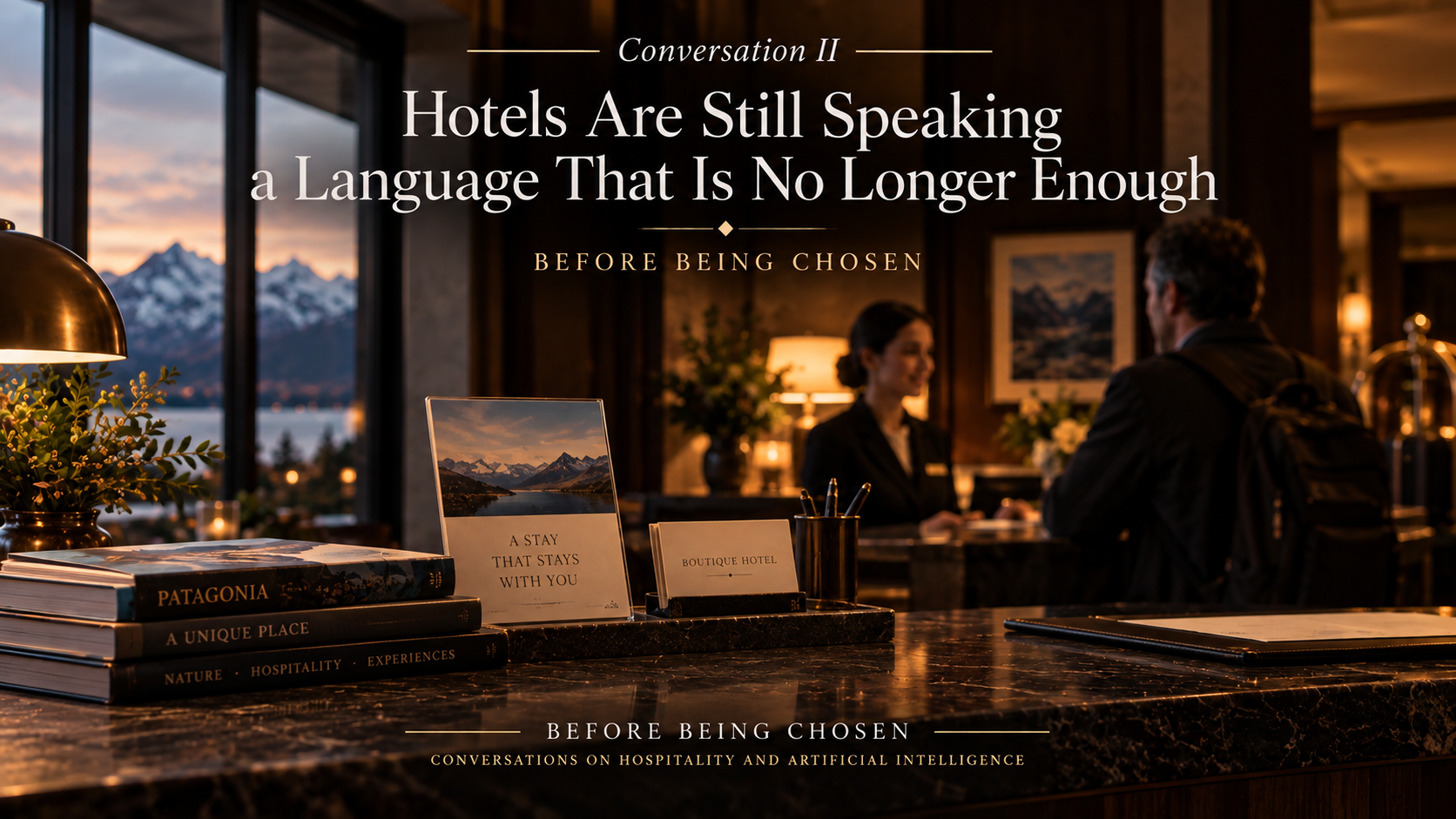
The first time I heard someone say that a hotel needed to “modernise its communication”, I assumed the conversation would revolve around a fairly simple question: what do we want to say about this place?
But almost from the beginning, the meeting took a different direction. The hotel website was projected on the screen as comments of every kind began to emerge. The photographs needed changing, the copy needed reviewing, the hotel’s Google ranking had to improve, the booking engine needed updating, the site had to load faster, and a welcome video should be added. As the minutes passed, more ideas appeared, all of them reasonable and, to a greater or lesser extent, necessary. By the end, however, I had the feeling that we had left the only truly important question unanswered.
No one had really talked about the hotel. We had discussed how to present it, but not what, exactly, someone who did not yet know it needed to understand.
For a long time, I thought that way of working was perfectly logical. Hotel communication had always been shaped by the way travellers reached us and, whenever that changed, we almost always responded in the same way: we changed the tools.
Over the years, I began to suspect that the real problem lay elsewhere. Changing a website may improve the website, but that does not necessarily improve the way a hotel is understood. The distinction may seem small, but in fact it completely changes the conversation we should be having.
A hotel can state the exact size of its rooms, list every service it provides, specify the speed of its Internet connection, mention breakfast times and publish flawless photographs of every space. It can do all of this correctly and still remain difficult to understand, because it is answering the questions the hotel itself has chosen to answer, rather than necessarily addressing the ones travellers need resolved before they choose.
That distinction remained largely hidden while travellers continued to search for themselves. Anyone who genuinely wanted to understand a hotel had time to explore its website, compare photographs, read dozens of reviews and slowly form a personal impression. The logic changes when a recommendation has to be made in a matter of seconds. Artificial intelligence does not need a hotel to state its identity explicitly, but it can only reconstruct that identity from the signals available to it and the relationships it is able to establish between them.
That was when I began to wonder whether we had spent quite some time trying to solve the wrong problem, believing that the challenge was to learn how to speak to artificial intelligence. Today, I suspect the real challenge was never there. It has always been about making a hotel capable of explaining itself clearly enough to be understood, because artificial intelligence can hardly be expected to understand precisely what the hotel itself has not yet managed to understand — and make recognisable — about who it is.
That conclusion forced me to reconsider the way we had thought about hotel communication for years. We had learned to write better descriptions, hire photographers, redesign websites, work on search visibility and manage our online reputation. None of that had been a mistake. The problem was that while we were perfecting the way we presented hotels, we rarely stopped to ask whether that communication actually made them understandable.
A website does not, by itself, represent the whole of a hotel’s digital identity. It exists alongside business profiles, booking platforms, guest reviews, media coverage, tourism organisations and the countless references other people make to the hotel online. Yet the website remains the place where the hotel has the greatest ability to organise its story, define its proposition and explain precisely what kind of experience it offers. Beyond serving as a channel for information and sales, it is one of the most important statements of identity the hotel can control.
Every photograph, every piece of copy, every description and every editorial decision contributes to answering a question the traveller may never explicitly ask: what kind of hotel is this, and who was it designed for?
That question carries a different significance today. When someone has a conversation with artificial intelligence, they do not expect to receive scattered pieces of information. They expect an answer in which that information has already been interpreted and organised around their needs. In this new environment, information must be sufficiently clear, connected and consistent to become the basis for a recommendation.
Without realising it, we were still using a language built for travellers willing to browse pages, organise the information and reach their own conclusions. Now we also had to learn to communicate for a world in which that work might be done before travellers ever came across our name.
That is why I began to look at hotels’ digital presence differently. I stopped asking only whether their websites were modern, attractive or well positioned. Instead, I began asking whether someone who had never heard of the property could look through the information available and understand its true character, the experience it offered and why it might be the best choice for a particular kind of traveller.
I discovered that this apparently subtle distinction completely changed the way I thought about hotel communication: the challenge was no longer simply to appear, but to be understandable.
Management Perspective
A hotel’s communication should not begin with the choice of tools, but with defining the experience it needs to make understandable. Only when the hotel clearly understands what it offers, which travellers it serves best and why its proposition deserves to be recommended does it make sense to optimise the channels through which others will try to discover it.
The Case Study
Over the conversations that follow, we will apply a first test to the digital presence of a boutique hotel in Patagonia. We will mentally remove its name and examine whether the remaining information allows us to understand what kind of hotel it is, who it was designed for and why someone might recommend it. This will not be a design exercise or an aesthetic assessment. It will be a way of measuring how clearly the hotel expresses its identity.
A Question Before Moving On
If you removed your hotel’s name from its entire digital presence today, would the information left behind make it possible to understand what kind of experience it offers, which travellers it serves best and why it deserves to be recommended?