For several weeks, the meetings always ended in the same way.
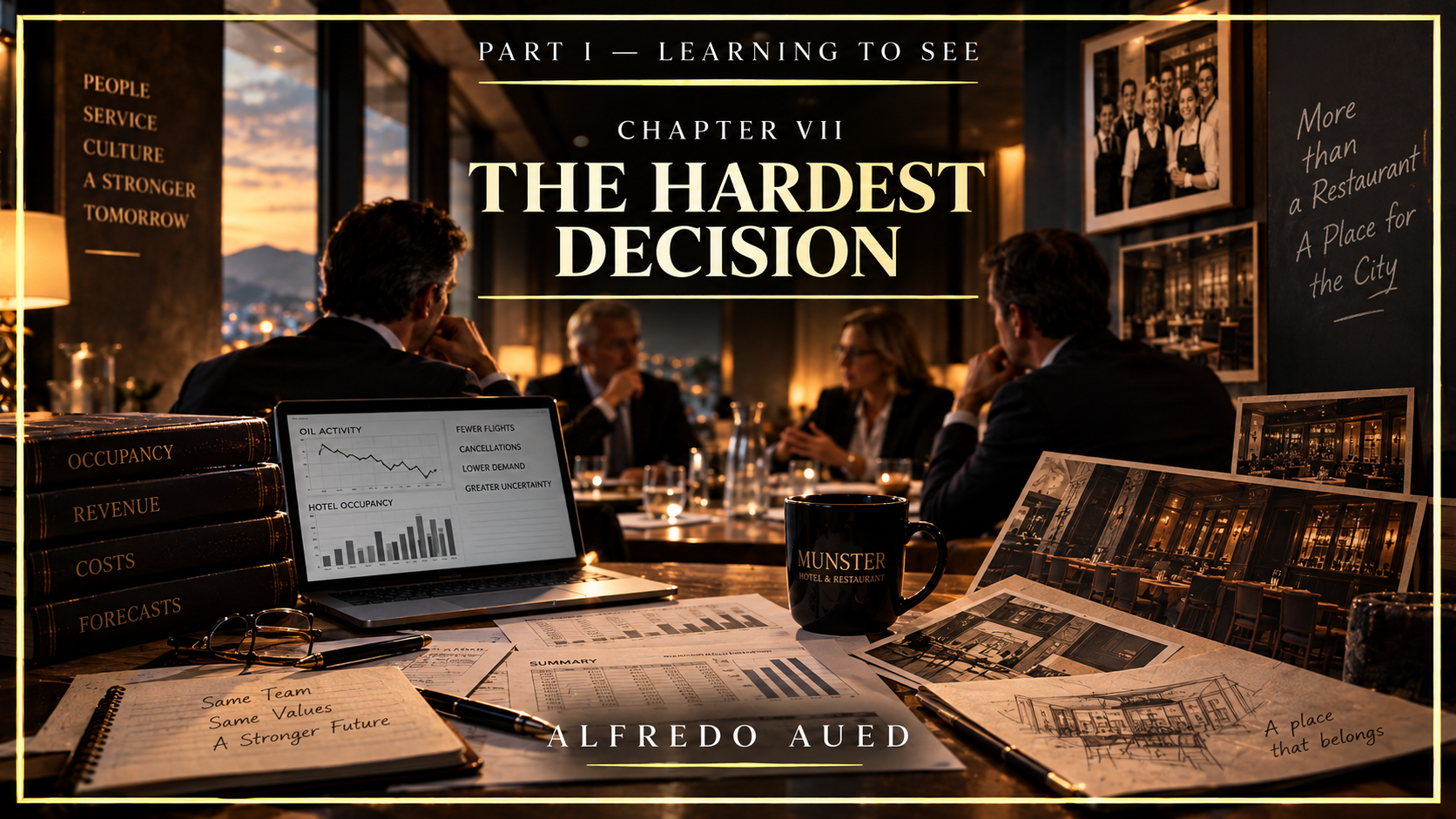
We would sit around a table to review occupancy, budgets and forecasts. The spreadsheets changed, the numbers did too, but the conversation invariably ended in the same place. Sooner or later, someone would ask again whether it made sense to open a restaurant precisely when hotel activity was beginning to decline.
The city was no longer the same. The downturn in oil activity had ceased to be an economic statistic and had become something we were beginning to notice every day. Some reservations were no longer being confirmed, flights were becoming less frequent and activity in the hotel was beginning to reflect an uncertainty that until then had seemed distant. It was not a sudden crisis. It was one of those quiet transformations that force you to reconsider decisions that only a few months earlier had seemed beyond question.
In that context, the idea of Munster returned again and again to the centre of the conversation.
It was not an improvised project. I had been imagining it for several years because I had always believed that a hotel should not depend exclusively on its guests. I was drawn to the idea of creating a place capable of becoming part of the life of the city, somewhere people would choose to go even if they did not have a room booked. While the hotel was growing, however, that possibility had never become more than a good idea. There was always some more urgent priority, some investment that seemed likely to offer a more immediate return or some reason to postpone it once again.
The crisis completely changed the meaning of that discussion. What for years had been an opportunity for growth was beginning to become an alternative way of protecting the hotel’s future. Suddenly, that idea was no longer competing with other projects. It was beginning to answer a much more uncomfortable question: how to get through an adverse period without giving up what had taken us the longest to build.
There were only a few of us around the table. The owner listened carefully as the spreadsheets passed from hand to hand and the forecasts tried to anticipate a situation none of us could know with certainty. Sitting opposite him was the company’s accountant, who was also his wife. I remember those conversations very clearly because she was probably the person who expressed the strongest reservations about the project.
Her reasoning was impeccable.
If activity was beginning to contract, taking on a significant investment seemed to be exactly the opposite of what prudence would suggest. Every new budget reinforced that conclusion and, the further the discussion went, the clearer it became that her resistance did not come from a lack of vision, but from a very concrete responsibility: protecting the assets they had built over so many years.
I never thought that position was wrong.
With time, I understood that this was precisely what made those meetings so difficult. No one disagreed about the situation we were facing, nor were we defending different interests. We were all trying to protect the same company. What really separated us was the way we interpreted risk and, above all, where each of us believed the solution should be sought.
Balance sheets, budgets and forecasts accumulated on the table. Almost all of them pointed towards the same conclusion: reduce costs, wait for conditions to improve and weather the storm with the leanest possible structure. It was entirely logical. In hospitality, when demand falls, that is usually the first reaction.
But as I looked at those spreadsheets, I could not stop thinking about everything that did not appear in any of them.
There was not a single cell capable of expressing the value of a receptionist who knew regular guests by name. Nor was there a formula capable of measuring the trust of a team that had worked together for years, or the time it would take to rebuild that way of working if activity ever began to grow again. For a long time, we had invested in developing people, passing on a way of welcoming guests, consolidating a working culture and building relationships that no balance sheet recorded as an asset.
And yet it was precisely that invisible asset that was now beginning to be at risk.
That was when I began to look at the project from a completely different perspective. Until then, I had always thought of Munster as a new business unit. Suddenly, I also began to see it as a way of protecting what we had already built. If we could generate an additional source of income, perhaps we could get through that period without breaking up the team that had taken us so many years to build. The discussion was no longer simply financial. At its heart, it had become a discussion about the future of the people who kept the hotel running every day.
I cannot say that I was certain the restaurant would succeed. That would be to reconstruct the past with a certainty that did not exist at the time. Opening a new business always means living with a considerable degree of uncertainty. The only thing that was beginning to seem clear to me was that continuing to depend exclusively on the same market might be an even greater risk than trying to build a different path.
Over the years, I came to understand that the discussion had never been only about gastronomy or an investment. It was really about the way an organisation decides to move through a crisis when every alternative seems reasonable and none guarantees the outcome everyone hopes for. Since then, I have seen companies respond by becoming smaller and others try to protect what they considered most valuable. I never came to believe that there was only one right way to act. Every organisation ultimately responds according to the history it has built, the risks it is prepared to take and, above all, what it decides to preserve when circumstances cease to be favourable.
Those meetings changed forever the way I understood leadership. From then on, I stopped thinking that managing meant only administering the resources available to me correctly. I began to believe that a manager’s real responsibility emerges when they have to decide what is worth protecting while everything around them seems to suggest that the time has come to give it up.
Over the years, I eventually understood that organisations do not change because uncertainty disappears. They change when someone accepts that continuing to wait is also a decision and that, in certain circumstances, it may be the riskiest decision of all.