During those meetings, I had defended the project with numbers, arguments and forecasts, although there came a point when I understood that no spreadsheet could express how far I was prepared to take that conviction. I remember saying that, if the investment was the problem, I would sell my cars and put up the money myself. I do not know whether anyone around the table believed I was serious.
I was.
By then, the restaurant had ceased to be a possibility that could simply be put back into a folder. After so many years imagining it, and so many weeks watching the hotel begin to feel the effects of a changing city, I had reached a point where giving up on trying seemed more difficult than accepting the risk of being wrong.
The proposal changed the tone of the conversation. Until then, we had been discussing what the company should do; from that moment on, we were also discussing what I was prepared to do. The alternative that eventually took shape contained something of both. If the restaurant managed to open, I would cease to be an employee and personally take responsibility for operating it under an agreement that was to be formalised later. The staff would become my responsibility, as would the costs, risks and obligations of an operation whose viability was still impossible to demonstrate. Seen from many years later, it might appear reckless. At the time, it simply seemed consistent with everything I had been arguing for so long.
Getting approval, however, was only the beginning. Restaurants are built with extraordinary speed inside a folder. One photograph can be placed beside another, a bar can change size with a single line and a lamp finds its place simply by moving a pencil a few centimetres. Buildings have a different kind of patience. There were the square metres available in one corner of the hotel, partially under construction, which had been waiting for a decision for some time. Whenever I walked in, I tried to superimpose onto those bare walls the images I had collected over the years. Some worked immediately; others, which had seemed perfect in a photograph taken thousands of kilometres away, felt completely foreign when I tried to bring them to Comodoro Rivadavia.
That was probably when the restaurant truly began to become Munster. I understood that reproducing what I had liked elsewhere would not be enough, because the space had to belong to the city in which it was going to live. Belgrano R could remain in my memory, Irish tradition could give it an identity and hundreds of restaurants could contribute details, but none of them knew the people who would one day sit at our tables. The challenge was to take all those references and somehow make them stop looking like references.
Construction progressed the way many projects do when resources are scarce: unevenly. There were periods when everything finally seemed to be taking shape and others when a purchase we could not make, a budget that had increased or a decision still pending brought weeks of progress to a halt. I learned to look at the work with a patience I had never possessed before. Every improvement immediately revealed the next need. When we finished a wall, we began thinking about the lighting; when the bar appeared, we discovered that the room still lacked the warmth we had imagined; when we finally found a piece of furniture, the question arose whether it truly belonged there or whether we simply liked it.
There were moments when the distance between that folder and what stood before us seemed enormous. Yet every now and then, some detail would reduce all those years to a few seconds. A piece of wood would finally acquire the right tone, a light switched on at the end of the afternoon would create exactly the atmosphere I had imagined, or the bar would begin, for the first time, to look less like a newly built structure and more like a place where someone might want to stay and talk. Then I would recognise again something I had seen many years earlier without knowing what I was looking at it for.
Meanwhile, the hotel continued operating and the crisis ran its course. Occupancy fell, companies cut their spending and the decision that had initially seemed too risky began to take on another dimension. We were no longer discussing only how to open a restaurant. Every step we managed to take brought us closer to the possibility of generating activity that did not depend on an airline reservation, a corporate training session or a travel authorisation from an oil company. For the first time in many years, we were trying to build a source of activity whose origin lay only a few blocks from the hotel.
When opening finally began to seem possible, a concern that had remained in the background throughout the process came to the surface. We might have chosen the right woods, designed a good bar, prepared an extensive menu and achieved lighting that resembled what I had imagined for years.
None of that guaranteed that anyone would want to come in.
On opening day, I remember walking around the dining room far more times than necessary. I adjusted a chair that was probably already in the right place, looked over a table, went back to the bar and asked questions about things that had almost certainly been checked several times. The team knew what they had to do and the kitchen was ready. There was nothing useful left for me to do, and yet I found it impossible to stand still. After so many years thinking about the place, the moment had arrived when it would cease to belong to us.
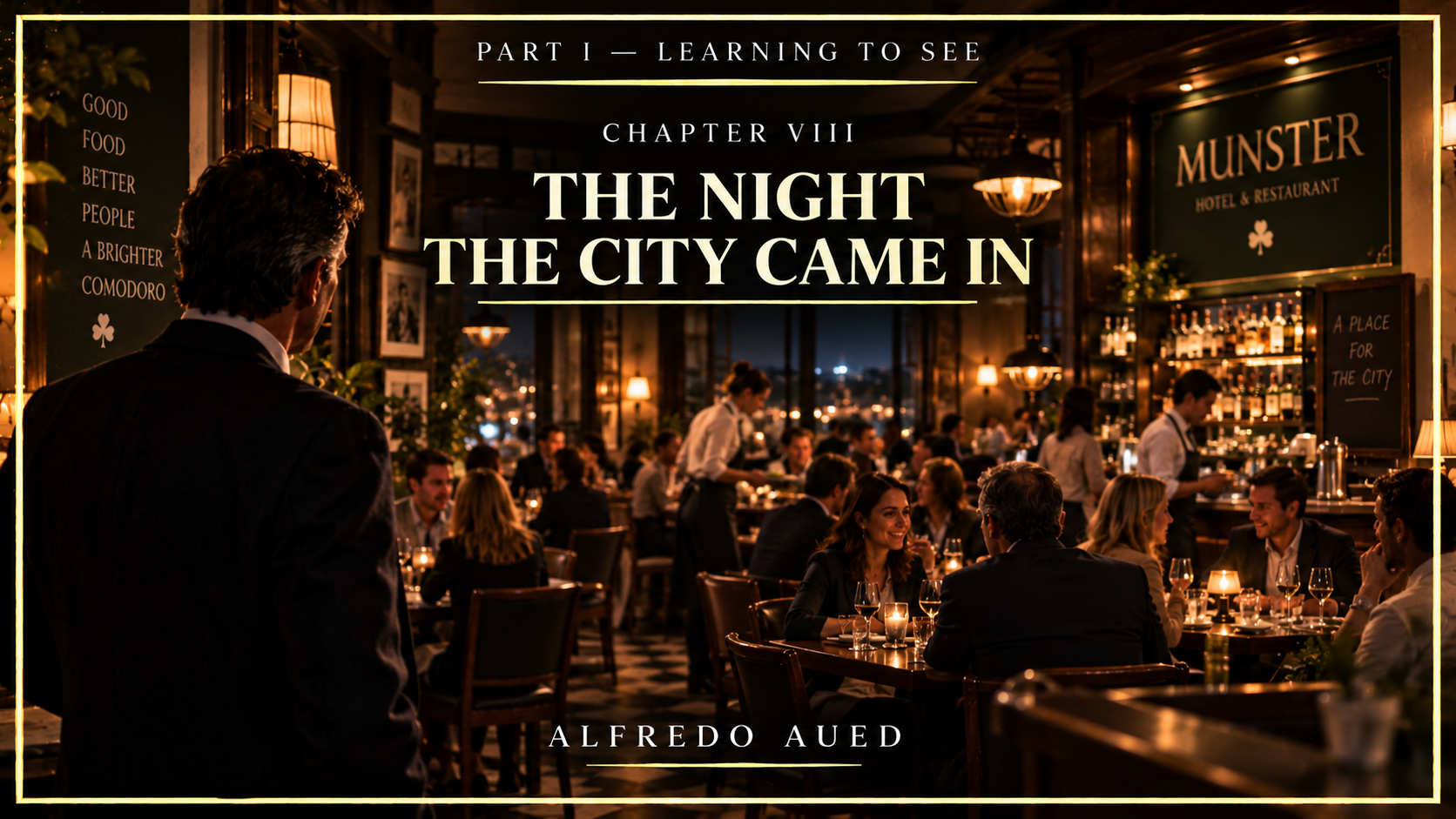
The first people came in with that almost disappointing naturalness with which moments we have imagined for too long so often occur. No one stopped at the door to announce that something important had just happened. They simply arrived, asked for a table and sat down. Then another couple came in, later a family and, little by little, the dining room began to acquire a sound that until then had existed only in my head. Conversations mingled with the music, the first dishes began leaving the kitchen and behind the bar appeared that movement, disorderly and precise at the same time, that places acquire when they begin to fill with life.
For a while, I stood watching from one end of the room. There were people I did not know. None of them had a room booked. They had not arrived from the airport and they were not there because a company had contracted our services.
They had left their homes and chosen to come in.
That was when, without intending to, I remembered those walks through Comodoro and the question that had accompanied me for so long. For years, my work had consisted of getting travellers from other cities to choose our hotel. That night, for the first time, the direction of movement had reversed.
The city had come in.
The months that followed confirmed something that first night had only allowed us to glimpse. Munster began to build an identity of its own, and people who had never had a reason to enter the hotel began doing so to have dinner, meet friends or spend an evening with their families. The restaurant generated revenue, but it also produced something no initial budget had been able to anticipate fully: it extended the life of the hotel beyond its rooms. When oil activity slowly began to recover and corporate travellers returned, they found a different hotel from the one they had left. It no longer had only guests.
It also had part of the city living inside it.
The agreement we had imagined before the opening was never ultimately formalised in the way we had planned. The restaurant’s success changed the circumstances, and I continued in my role within the company while Munster grew as an integrated part of the operation. For a long time, I thought about that in terms of contracts that were never signed and professional paths that might have been different. Over the years, I gradually stopped doing so. When I return to those days, what remains is neither a document nor a corporate structure.
It is that first night.
I can still imagine myself standing at one side of the dining room, watching people talking around tables that for years had existed only in photographs, notes and memories. Some of the lamps came from ideas gathered during my travels; the wood inevitably took me back to that restaurant in Belgrano R; other details had changed so many times during construction that I could no longer remember where they had come from. Everything that had once been separate was finally beginning to coexist within the same place.
Many years earlier, a student had walked from an Irish school to a nearby restaurant without suspecting that he was storing away the first image of something he did not yet know how to name. Then came the journeys, the folder, the city, a crisis, discussions around a table and a construction project that seemed never to end. None of those moments had been enough on its own to create Munster.
Perhaps that is why, when it finally opened its doors, I did not feel that I was inaugurating something new. As I looked at the full dining room for the first time, I felt instead the strange sensation of recognising a place I had been trying to reach for many years.